The gold price has been hovering around the $1,400 an ounce level for the better part of a week, but on Thursday the metal fell back again.
By midday gold for delivery in December, the most active contract on the Comex in New York, was trading at $1,387 down 1.8% or $25 from Tuesday’s close as profit-takers sell into any gold strength that’s available.
Gold gained 5.7% in August and briefly reach a three-month intra-day high of $1,434 last Wednesday, but moving significantly higher appears impossible for now.
Gold has also rallied sharply from the intra-day low of $1,182.60 an ounce hit on June 28 which temporarily pulled the gold market out of bear territory, but that momentum seems to have been mostly lost.
The $1,400+ resistance level has proved insurmountable despite a number of factors working in gold’s favour (but, if it does not pan out as expected, would be bearish):
- The threats of military action by the US on Syria boosting gold’s status as a safe haven asset (but the risks seem to have been largely priced in with even oil’s reaction muted).
- A currency crisis in emerging markets which encourages hedging using gold (but it could also have the opposite effect – vide India)
- An industry-wide strike by gold miners in South Africa, at more than 170 tonnes per year, the world’s number five producer (but supply is not nearly as big a factor in the gold market compared to industrial metals and South African strikes tend to be violent but short).
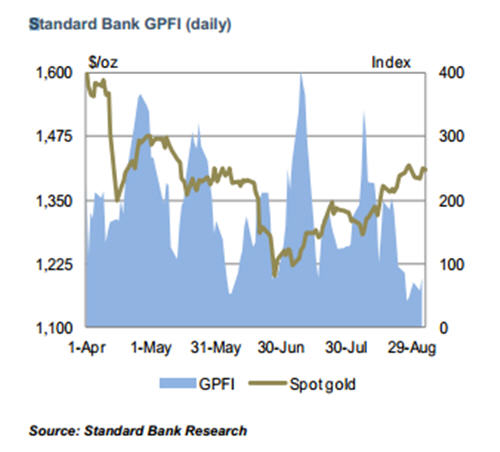
Standard Bank in a research note today makes a strong case that gold’s inability to form a new base above $1,400 is because Asian physical buying in Asia dries up when the price moves much above this level:
- Standard Bank Gold Physical Flow Index (GPFI), which predominantly tracks Asian physical buying and selling, has declined in recent days (see chart).
- The Shanghai Gold Exchange premium has fallen to $11 an ounce, well below the $20 more Chinese buyers were willing to pay through August and July and far from the $37 peak when the gold price was close to $1,200.
- “One has to question the sustainability of a move in the gold price much higher without strong physical demand, especially with our view that US 10-year bond yield will move towards 4% over the next 12 months.”
- The seasonal demand as India enters its festival period is predicted to be weak – heavy buying when gold was trading closer to $1,200 means Indian stocks may have been replenished already and the record low rupee could encourage scrap selling.
It is not just Asian consumers who wait for bargain basement prices.
After a brief hiatus in August, selling of gold-backed exchange traded funds (ETFs) has now recommenced with the world’s largest gold ETF, the SPDR Gold Trust, reporting outflows of 1.8 tonnes.
A good barometer of underlying gold demand – US sales of gold coins – have also fallen sharply.
Gold’s dramatic fall in April saw 209,500 ounces worth of American Eagle coins being picked up by bargain hunters.
By August this momentum had been completely halted. The United States Mint only managed to move a measly 11,500 ounces over the entire month.